For years, higher education institutions have relied on Early Alerts systems to help identify students who may need additional support. These systems bring together important student information and allow student success teams to establish criteria for identifying students who may be struggling. But there’s a practical challenge that can easily get overlooked: Having access to student data isn’t the same as being able to easily use it.
Traditional Early Alerts workflows often depend on staff knowing how to work with filters, datasets, categories, and predefined rules. For institutions with dedicated data teams, that may not be a major obstacle. For a student success professional who simply wants an answer to a specific question, it can create unnecessary friction.
AI is changing that part of the workflow. Instead of requiring users to know how to filter the data, modern Early Alerts tools can let them simply ask what they want to find. That may sound like a small change. In practice, it can make student data much more accessible to the people who use it every day.
The Old Way: You Need to Know How to Filter the Data
Imagine a student success advisor wants to find students with a GPA below 3.0. The question itself is simple, but in a traditional data workflow, getting the answer may require several steps.
Someone needs to know:
- Where the relevant student data is located
- Which field represents GPA
- How to apply a numerical filter
- How to set the appropriate threshold
- How to combine that filter with other criteria
- How to run and review the results
The technology may be capable of answering the question. The challenge is that the person asking the question may need technical knowledge to get there. This creates a dependency on people who know how to work with the underlying data.
A data analyst or administrator may be perfectly comfortable building these filters. But student success teams shouldn't necessarily need to become data specialists just to explore the information they already have access to.
The New Way: Ask the Data in Plain Language
AI introduces a much simpler interaction. Instead of manually configuring a filter, a user can ask “Show me full-time students with a GPA below 2.5.” or “Show me first-generation students with a tuition balance of $500 or more.”
With QuadC's Early Alerts AI Advisor, these natural-language requests are converted into live database queries, and the corresponding students are returned in the Early Alerts workspace. The user doesn't need to know the technical structure behind the query. They just need to know what they want to find.
The underlying data hasn't changed. The way people interact with it has.
Traditional approach:
Know the data → Build the filter → Run the query → Review the students
AI-powered approach
Ask the question → Review the students
Why This Matters for Student Success Teams
Student success professionals already know the kinds of questions they want to ask.
They might want to identify students who:
- Have a GPA below a certain threshold
- Are experiencing academic difficulties
- Have specific financial circumstances
- Meet particular demographic or enrollment criteria
- Match multiple conditions at once
The barrier isn't necessarily knowing what to look for. It's knowing how to translate that question into a data query. Natural-language AI reduces that barrier. Instead of asking a staff member to learn a technical filtering system, the system can allow them to communicate the criteria in the same way they would describe them to a colleague.
This makes student data more approachable for the people closest to student support. And it changes the role of technical expertise. Data expertise can still be valuable. But it doesn't have to be a prerequisite for every question a student success professional wants to ask.
From “Build a Filter” to “Ask a Question”
Consider the difference in workflow.
The old way
A student success professional wants to identify students with a GPA below 3.
They may need to:
- Locate the appropriate dataset.
- Identify the GPA field.
- Configure a numerical filter.
- Set the threshold.
- Apply additional criteria if necessary.
- Run the filter.
- Review the resulting students.
The new way
The user asks: “Show me students with a GPA below 3.”
The AI Advisor interprets the request, converts it into a database query, and generates the corresponding results. The difference is removing the technical steps between the question and the answer.
AI Doesn't Replace the Student Success Professional
This distinction is important. The role of AI in this workflow isn't to decide which students deserve support or replace the judgment of advisors. Instead, it helps staff work with the information more easily.
Once students are identified, QuadC allows users to review calculated risk scores and active or pending cases. The AI Advisor can also provide a plain-language explanation of why a student is marked as at risk and which indicators contributed to the score.
The professional still decides what the information means in context and what should happen next. AI simply makes it easier to get to the information in the first place.
Finding Students Is Only the Beginning
Identifying a group of students is one part of the Early Alerts workflow. The next step is turning that information into support. In QuadC, users can select students from filtered results and create pending cases.
Those cases can be assigned a service type, priority level, and reviewer before being routed for review. Advising leaders can then review pending cases, refine the details, and convert them into active alerts. Alerts can be routed to departments such as advising, counselling, mentoring, or tutoring, with relevant context and priority levels attached. It makes it easier to move from student data to student support.
This creates a workflow that connects the initial question to the next step:
Ask → Find → Review → Route → Support
A More Accessible Way to Work With Student Data
This shift becomes especially important as institutions continue to collect more information about students. More data can create more possibilities for student success teams, but only if those teams can actually work with it.
If every new question requires technical assistance, data can become something that staff wait to access rather than something they can actively explore. Natural-language AI changes that dynamic.
A student success professional can start with a question rather than a technical process.
“Which students meet these criteria?”
“Show me students with this combination of characteristics.”
“Which students fall below this threshold?”
The system can handle the technical translation. The professional can focus on interpreting the results and deciding what to do next.
From Data Expertise to Data Accessibility
The biggest difference between old and new Early Alerts workflows isn't necessarily the amount of data available. It's who can effectively use that data.
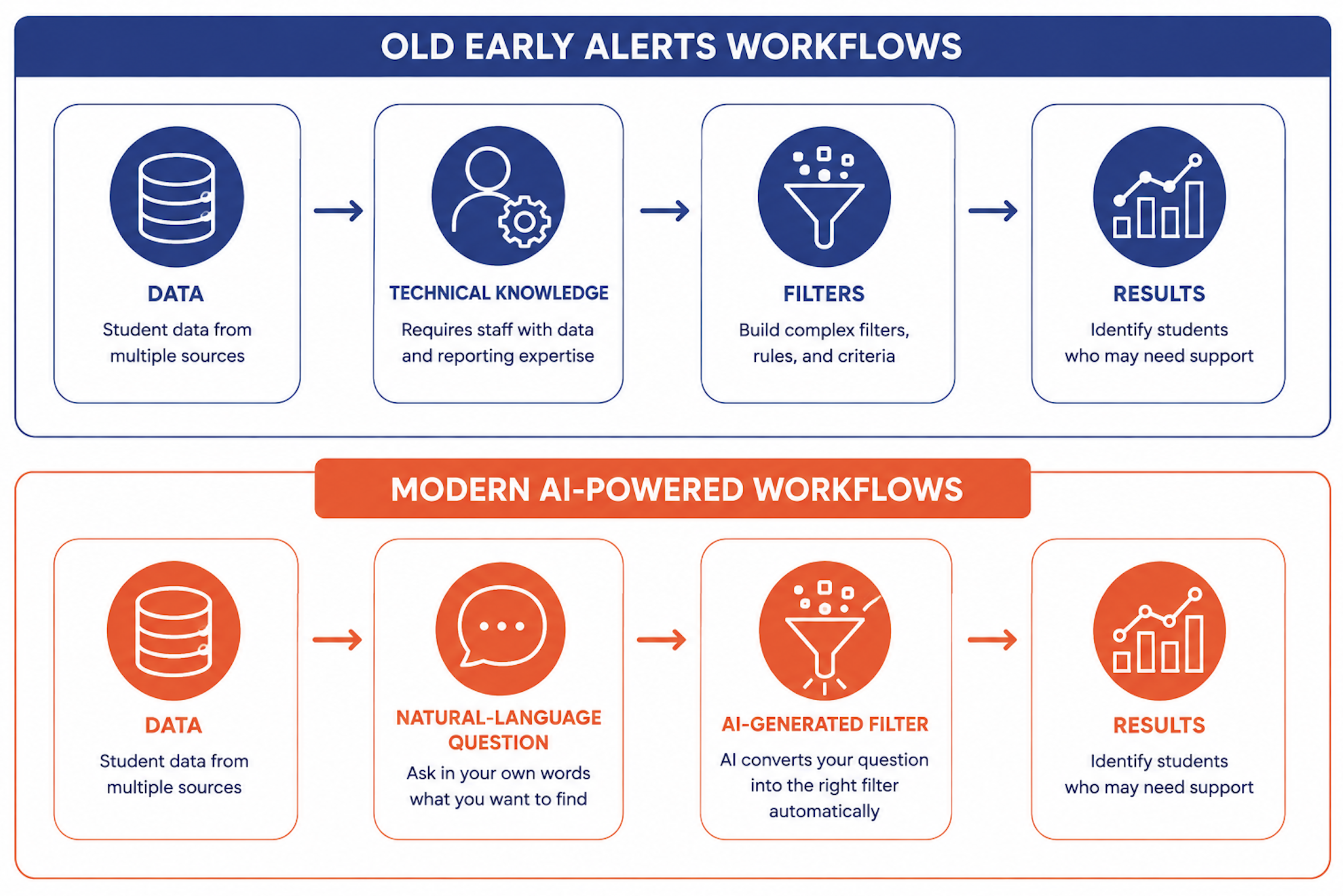
A modern Early Alerts system doesn't have to promise that AI can predict every student who will struggle. It can deliver value by making it faster and easier for student success teams to find the students they're looking for. And when those teams can ask questions directly, they spend less time figuring out how to manipulate data and more time using that data to support students.
What Comes After Identification?
Once a student has been identified and an alert becomes active, student success teams need context to determine how to respond. QuadC's 360° Student Health View brings information such as risk scores, enrolled courses, assignment performance, academic trends, sessions, and staff notes into the student's profile. Teams can also manage alerts, create action plans, assign specific tasks, and track progress toward resolution.
So while natural-language filtering makes it easier to find the right students, the broader Early Alerts workflow helps teams continue working with those students once they've been identified.
The Future of Early Alerts May Be Simpler Than We Think
When people talk about AI in higher education, it's easy to focus on increasingly sophisticated predictions and automation. But sometimes the most meaningful improvement is much simpler: Making technology easier for people to use. Student success professionals shouldn't need to understand database structures or advanced filtering logic to ask questions about their students. They know what they're looking for. AI can help translate those questions into something the system understands.That means the evolution from traditional to AI-powered Early Alerts removes the technical barrier between a question and the data needed to answer it. The old way required you to know how to filter the data. The new way lets you ask for what you need.
And for student success teams, that can make finding the right students faster, simpler, and more accessible.